
August 31, 2026
|15 min read
The Price You Never Approved: The Unbudgeted Cost of Running Animal Health Studies on Today’s Data Stack
Every animal health study runs up a cost that no one signed off on and that never made it into a purchase order. It is the staff time spent moving data by hand between paper forms, spreadsheets, emails, and clinical software built for human trials rather than animal ones, plus the oversight all those tools take to run. This process was a sensible choice when it was put in place. It still carries an unbudgeted cost.
That cost can and should be estimated, and it should serve as the baseline for assessing any tool that would replace the current setup.
TL;DR
- Running animal health studies the current way carries a cost no one budgeted or approved: staff time spent moving data by hand, plus the overhead of every tool used in the process.
- That cost can be estimated from three categories for which the inputs are already available: manual data labor, submission scrub, and vendor oversight.
- Even a small, conservative program comes to about half a full-time person a year.
- Each added tool multiplies the overhead, which is why vendor consolidation is a recognized procurement objective.
- A data problem caught at the regulator costs twice, in internal rework and in delayed market access, both separate from the annual total.
- The same standard procurement uses for a new vendor should be used to assess the current tools and any replacement.
What Does the Current Setup Actually Cost?
Let’s look at the easy part first: the license and support fees for the current tools are a known quantity. They come as invoices, have budget lines, and renew on schedule. Estimating the unbudgeted cost requires a bit of math using data animal health teams already have.
Three things make up the annual cost of running studies the current way:
- Manual data labor: the staff time spent transcribing entries from paper or devices, re-keying data between systems, reconciling versions, and correcting errors. This effort needs to be counted for everyone who touches study data, from coordinators and investigators to data managers and monitors.
- Submission scrub: the pre-submission cleanup before a report gets sent to the sponsor or regulator, covering query resolution, dataset assembly, and consistency checks.
- Vendor oversight: the internal time each tool takes to run, including contract and renewal negotiations, security reviews, qualification files, and invoices. This is the category made up of procurement’s own hours rather than the study team’s.
Each of the three works the same way: an amount of effort, spent over the weeks a study runs, times the hourly rate. Totaled across a year of studies, they approximate the annual cost of the current setup.
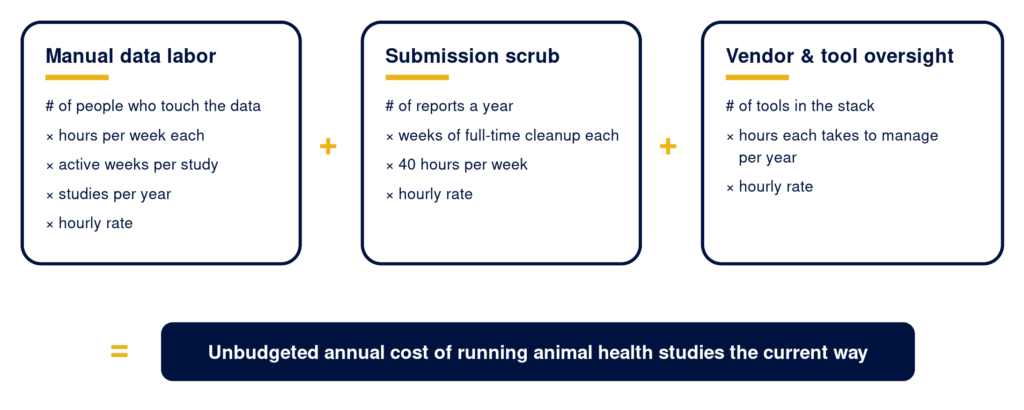
Figure 1: Three cost categories, manual data labor, submission scrub, and vendor oversight, make up the calculation to estimate the annual cost of running animal health studies with the current tech stack.
Applying the formula to a small program consisting of only a few studies a year, with a small number of people touching the data for a few hours each a week and a modest hourly rate, comes to roughly $59,800 a year. That is about half a full-time person, spent on keeping the status quo. The inputs for this calculation were deliberately conservative and are meant to be replaced with actual numbers based on the study size and the experience of the team running them. Using more realistic numbers will likely push the final figure higher rather than lower.
That final figure is not only the cost of doing the work. It also includes the extra work of finding and correcting transcription errors. Those mistakes are common and trace to a single source: every manual transfer of a data point is a chance to introduce an error that later has to be caught and fixed. In human clinical research, a 2026 multi-site assessment measured a manual transcription error rate of 8.23%. The rate was effectively zero when the same data moved into the system without a manual transcription step. That rate is not animal-health-specific, but the manual transcription step is the same in animal studies that rely on manual record keeping and transcription.
The figure understates the burden in two further ways:
- Animal health study budgets are a fraction of human-pharma trial budgets, so every manually handled hour takes a proportionally larger share of the study than it would in human pharma.
- The dollar figure leaves out the cost of losing institutional knowledge. In the small teams typical of animal health studies, the knowledge of how a study’s data is structured and reconciled is often concentrated in one person, so a departure or a long absence puts continuity at risk with no backup, and can result in decreased efficiency and increased training cost.
Even set low, and leaving the last two factors uncounted, the numbers add up to real money and a nontrivial share of a small team’s time.
What Does a Fragmented Tool Stack Really Cost?
Every tool in the stack carries its own contract, security review, qualification file, invoice stream, and renewal calendar. Those are the hours the calculation counts as vendor oversight, and they increase with each vendor added, regardless of whether the license is expensive or cheap. That administrative load is what consolidation targets.
Reducing vendor count is a recognized procurement objective. In ADAPT’s CIO Edge research (published 2025), 68% of technology leaders planned to consolidate vendors, with those pursuing it targeting a 20% cut in supplier count. In human clinical development, sponsors are reducing vendor counts by 20 to 40% and moving from trial-level contracts to enterprise-wide partnerships (Beroe, 2026). In animal health specifically, outsourcing of preclinical and clinical work is growing, reaching 42% of work in 2025, up from 31% five years earlier (Mordor Intelligence). As more of a study is outsourced, more of its data crosses between organizations, adding more relationships to oversee and more points where data has to be moved and reconciled.
Procurement is increasingly positioned to shape tool and vendor selection earlier than it used to. A typical enterprise purchase now involves 13 internal stakeholders, and procurement is a decision-maker in more than half of buying cycles, engaging from the start rather than as a final checkpoint. Its scrutiny also reaches past price, weighing features and functions for the efficiency and productivity they deliver rather than the license fee alone (Forrester, 2026). That puts procurement professionals in a unique position to apply the same level of rigor to the tools already in place.
Consolidation is not without risk: fewer vendors mean more depends on the ones that remain, the well-known “all eggs in one basket” issue. That risk is real, and it can be managed by requiring data-export guarantees and escrow in the contract.
What Does It Cost to Replace a Tool Every Time a Study Changes Size?
Animal health studies vary enormously in size and complexity. A group-housed livestock study recording hundreds of animals a day places completely different demands on a data tool than a small companion-animal pilot study or a large multi-site pivotal program. A tool that fits one set of demands often does not fit the others.
A tool chosen to fit only part of that range forces one of two outcomes later.
The first is a change tax: replacing the tool when it cannot meet the demands of the next study. That means waiting for a new procurement cycle, conducting another security and IT review, undertaking another qualification effort, retraining staff, and migrating existing data into the new system. These costs recur with every switch, and they are rarely recorded anywhere.
The second is accepting a poor fit between the study and the tool: building workarounds and absorbing the daily friction of using a tool that was not built for the study it is being used for.
Choosing one tool that covers the full range of possible studies avoids both. A tool capable of handling everything from pilot to pivotal study incurs neither a change tax nor the cost of workarounds.
What Does a Data Problem Cost Once a Study Reaches the Regulator?
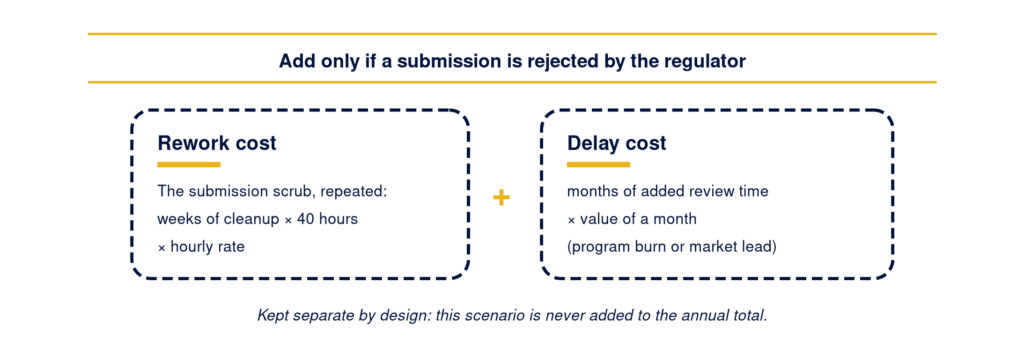
The cheapest data problem is the one caught early. If issues surface during regulatory review, two additional unbudgeted costs can arise: work that has already been done, such as data cleaning and analysis, may have to be repeated, and the timeline to market gets pushed back.
The FDA Center for Veterinary Medicine (CVM) has been clear about how submission quality affects review.
When a submission is deficient, CVM guidance tells sponsors not to resubmit until they have reviewed the package thoroughly for accuracy and completeness (Guidance for Industry #119, 2002). A data problem found at submission is therefore not a quick fix. It costs a full review cycle.
CVM has also stated that raw data from safety and effectiveness studies is what gives it confidence in its decisions (GFI #287, 2025). Gaps or inconsistencies in that data go to the core of what the agency evaluates, and are exactly the kind of problem that stalls a review.
CVM wrote its content and format guidance to make review more efficient, after finding that reviewers often could not locate required elements in a submission (GFI #104, 2001, applies to non-food-animal submissions). Submission quality is therefore not only about correct data but about whether a reviewer can find what they need. A submission that is hard to navigate slows the review down. CVM has also published a documented framework for submitting electronic data files, audit trails, and analysis programs (GFI #197, revised 2020), including a stated preference for receiving the EDC study database together with its audit trail. For anyone wondering whether the regulator is ready to receive electronically captured data: it has a template waiting.
These scenarios are not hypothetical. CVM’s reviewers have examined every animal drug submission containing study data since 2015, and published the issues they cite most. At the top of that list for paper-based studies is that the final study report does not fully and accurately reflect the raw data (CVM QASR, 2023), the exact failure a hand-transcribed, manually reconciled workflow produces. When data issues surface at review rather than during the study, the fix is to rework the data and accept the cost and delay that causes. For more on what CVM cites most often, see What FDA’s CVM Cites Most in Animal Study Submissions.
Wondering which of CVM’s published findings your own study would run into? The free CVM Submission Readiness Check returns a gap summary in minutes.
What Should Procurement Require from Any Tool That Replaces the Current Setup?
Procurement already runs a checklist on every new vendor, tracking factors such as total cost of ownership, security and IT review, data portability, and reference checks. The tools already in place rarely faced the same level of scrutiny, because most were adopted before procurement had a seat at the table. Running that same checklist on the current stack, and on anything proposed to replace it, is a way to quantify the unbudgeted cost and to decide deliberately whether it is acceptable or too high.
Eight questions are critical for making an informed decision:
- Coverage: does one tool handle every study type and species the organization runs, from the smallest pilot to the largest multi-site program?
- Time to value: how fast can a study go live, and does the effort scale down for simple studies rather than staying fixed?
- Adoption burden: how quickly does a field technician become proficient and productive, and what support exists when a live study hits a problem?
- Ecosystem: is the tool already in use at the organization’s own CROs and sites, so the learning curve is shorter and the integration steps are known?
- Connectivity: does the solution offer documented application programming interface (API) access and support standards-based data exchange with the surrounding systems, rather than requiring manual export and re-import?
- Continuity: if the vendor fails, is the software held in escrow, where a neutral third party holds it and releases it to the customer, so operations can continue?
- Portability: if the relationship sours, can the customer move to an alternative, with guaranteed data export in a standard, non-proprietary format and a bounded switching cost? Does the contract cap price and renewal increases, so the customer is not locked in?
- Evidence: are there measured before-and-after results from real deployments, such as error rates, cleanup time, and cost?
Several of these questions, coverage, evidence, and adoption burden, are answered best by seeing the tool in use. A trial before full commitment is now standard practice: more than 60% of business buyers run one before they buy, rising to 78% on purchases above $10 million (Forrester, 2026).
Study slates are usually locked months before a fiscal year begins, so a decision made after that point waits for the next cycle, and the current cost is paid again in the meantime.
The current setup has a price. The only open question is whether it keeps being paid by default, or gets measured and benchmarked against the alternatives.
Grade Your Own Tech Stack
The three-part calculation in this article works on your numbers, not ours. Our worksheet walks you through it line by line, then turns the eight questions above into a scoreable checklist you can take into any vendor conversation.
It is free, it takes about ten minutes, and it starts with the stack you already own.
FAQs
Lock-in is two separate risks, and each is handled by a contract term negotiated before signing. The first is losing leverage by depending on a single vendor with no real alternative, which allows them to raise prices or reduce service. The second is retrieving your data and continuing to operate if the vendor fails. Leverage is maintained by negotiating a guaranteed right to export data in a standard, non-proprietary format, keeping the cost of switching low and predictable by owning data and study configurations outright and keeping integrations documented, and capping price and renewal increases in the contract. The ability to leave on fair terms is what keeps a vendor accountable while the relationship is healthy. Exit is managed through software escrow: a neutral third party holds the software and releases it to the customer if the vendor fails, so operations continue rather than stopping when a single supplier disappears. Consolidation is worth pursuing, but only when these terms are secured up front, when the buyer has the most leverage, rather than after signing, when they have the least.
The labor is reduced, not just moved, because the first entry of the data is not the largest cost. Data still has to be captured initially, and that work does not disappear. A manual workflow, however, adds cost after capture: the same data has to be transcribed, re-keyed, reconciled, and reformatted before it can be analyzed. That repeated handling is where hours and errors accumulate. Structured capture removes the repetition, not the capture. Entered once, the data reaches analysis without repeated handling, avoiding those time-intensive and error-prone steps. Published clinical research describes the same effect: removing redundant data entry is what improves quality and speed. That research is human clinical, but the manual steps it measures are the ones animal studies run by hand. So the saving is real, and it comes from eliminating rework and errors.
Related Resources
- What FDA’s CVM Cites Most in Animal Study Submissions
- What Structured Data Changes for Your Study Team
- Making the Switch: From Paper to EDC
- Why Animal Health R&D Teams Resist Digital Tools
References
- Garza M. Advancing Clinical Trial Efficiency and Data Accuracy through Direct EHR-to-EDC Integration. AMIA Jt Summits Transl Sci Proc. 2026.
- ADAPT. 5 CIO Priorities for 2025: IT Modernisation, AI, and Business Value. CIO Edge research, 2025.
- Beroe. Clinical Development Services: Key Procurement Trends. 2026.
- Mordor Intelligence. Veterinary CRO Market. 2026.
- Forrester. The State of Business Buying, 2026. 2026.
- FDA Center for Veterinary Medicine. Guidance for Industry #119: How CVM Intends to Handle Deficient Submissions Filed During the Investigation of a New Animal Drug. 2002.
- FDA Center for Veterinary Medicine. Guidance for Industry #287: Raw Data for Safety and Effectiveness Studies. Finalized 2025.
- FDA Center for Veterinary Medicine. Guidance for Industry #104: Content and Format of Effectiveness and Target Animal Safety Technical Sections and Final Study Reports. 2001.
- FDA Center for Veterinary Medicine. Guidance for Industry #197: Documenting Electronic Data Files and Statistical Analysis Programs. Revised November 2020.
- Lazo A, Davis D, Desilva J, Smith E, Rhodes L, Cottrell E. QASR Hot Topics. FDA Center for Veterinary Medicine, Office of New Animal Drug Evaluation. Society of Quality Assurance Annual Meeting, March 2023.
- Prelude. Animal Study Submissions: What FDA’s CVM Cites Most and How to Design Your Next Study Around It. 2026.
Subscribe to our newsletter and stay up to date on the latest.
Sign up for our newsletter